Places to Eat in London
 London is a place where all cultures melt. Here you will find food
from all parts of the world. This little article will give you a brief on
eating places in London.
London is a place where all cultures melt. Here you will find food
from all parts of the world. This little article will give you a brief on
eating places in London.
It is a huge task for a visitor to find the 'right place' to eat in London - with the 'right atmosphere', at the 'right price' - largely because, as in any big city, there are literally thousands of venues from which to choose, ranging from fast food joints, pubs, and mainstream chains all the way up to some of the most exclusive restaurants in the world which attract the kind of clientele that don't need to ask the price.
Sorting the good from the bad isn't easy, but London has something to accommodate all budgets and tastes. Following is a rough guide to what you might get, should you fancy eating out:
£5 - you can get a good English pub or cafeteria breakfast with a rack of bacon, beans in tomato sauce, egg, sausage, orange juice and coffee or tea. Most pubs stop this offer at 11AM.
£7 - will buy you a couple of sandwiches and a soft drink, some takeaway fish and chips, or a fast food meal. There are also a number of mostly Chinese restaurants which serve an all you can eat buffet for around this price. These are dotted about the West End and it is well worth asking a member of public or a shopkeeper where the nearest one is. These restaurants make much of their revenue on drinks although these are usually still moderately priced. The food whilst not being of the finest standard is usually very tasty and the range of dishes available is excellent. There are literally thousands of so called takeaways in London and a cheap alternative to a restaurant meal. Check with your hotel management if they allow food deliveries before ordering in. Most takeaways will offer some form of seating, but not all do.
£6-10 - will get you a good pub meal and drink or a good Chinese/Indian/Italian/Thai/Vietnamese buffet. Be aware that many pubs have a buy-one-get-one-free offer, and you can either order two main dishes for yourself or bring a friend.
£15 - some more expensive French, Mediterranean and international restaurants do
cheaper two or three course lunch menus.
£25 - offers you a lot more choice. You can have a good meal, half a bottle of
wine and change for the tube home. There are plenty of modest restaurants that
cater for this bracket.
£50 (to almost any amount!) - with more money to spend you can pick some of the
city's finer restaurants. It may be a famous chef (like Jamie Oliver or Gordon
Ramsay) or simply a place that prides itself on using the finest ingredients.
Worth the splurge to impress a special someone. Note that these establishments
often need to be booked well in advance, and most will enforce a dress code of
some sort.
 Prices inevitably become inflated at venues closest to major
tourist attractions - beware the so-called tourist traps. The worst tourist trap
food is, in the opinion of many Londoners, is served at the various steak houses
(Angus Steak House, Aberdeen Steak House etc - they are all dotted around the
West End). Londoners wouldn't dream of eating here - you shouldn't either!
Notorious areas for inflated menu prices trading on travellers' gullibility and
lack of knowledge are the streets around the British Museum, Leicester Square
and Piccadilly Circus. Even the major fast food chains charge a premium in their
West End outlets - so watch out.
Prices inevitably become inflated at venues closest to major
tourist attractions - beware the so-called tourist traps. The worst tourist trap
food is, in the opinion of many Londoners, is served at the various steak houses
(Angus Steak House, Aberdeen Steak House etc - they are all dotted around the
West End). Londoners wouldn't dream of eating here - you shouldn't either!
Notorious areas for inflated menu prices trading on travellers' gullibility and
lack of knowledge are the streets around the British Museum, Leicester Square
and Piccadilly Circus. Even the major fast food chains charge a premium in their
West End outlets - so watch out.
In the suburbs, the cost of eating out is reduced drastically. Particularly in large ethnic communities, there is a competitive market which stands to benefit the consumer. In East London for example, the vast number of chicken shops means that a deal for 2 pieces of chicken, chips (fries) and a drink shouldn't cost you more than £3, and will satisfy even the largest of appetites. Another good (and cheap) lunch option is a chicken or lamb doner (gyro) at many outlets throughout the city.
Tipping may also be different than what you're used to. All meals include the 17.5% VAT tax and some places include a service fee (10-12%). The general rule is to leave a tip for table service, unless there's already a service charge added or unless the service has been notably poor. The amount tipped is generally in the region of 10%, but if there's a figure between 10 and 15% which would leave the bill at a conveniently round total, many would consider it polite to tip this amount. Tipping for counter service, or any other form of service, is unusual - but some choose to do so if a tips container is provided.
Restaurant streets
Whilst central London is full of restaurants and cafes it is useful for the
visitor to be aware that there are some areas where the majority of diners are
Londoners, rather than tourists, and in general you will get a much more
pleasant, better value, and less crowded eating experience than you will find in
the West End. These places are best visited in the evenings.
Upper Street Head to Highbury & Islington (Victoria line) or Angel (Northern line). Dozens of excellent restaurants, popular with young professionals.
Clapham Junction is not just a train station - but also home to many good restaurants and bars, in particular on Lavender Hill and Battersea Rise
Lordship Lane in the southern suburbs - head to East Dulwich station - a good selection of european restaurants and a few award winning gastropubs
High Street Croydon Croydon is derided by most Londoners as the end of the earth, however this suburban gem of a road has at least 30 decent restaurants, including three Argentinians, a South African curryhouse, a couple of fancy modern European brassieres, and just about every over type of cuisine you can think of. Sadly chain restaurants are moving in (Zizzi's, Pizza Express) but most of the places are still independent. Get a quick train to East Croydon station from Victoria or London Bridge.
Restaurants of London
As one of the world's most cosmopolitan cities, you can find restaurants serving food cuisine from nearly every country, some of it as good as, if not better than in the countries of origin.
Indian food in London is especially famous and there is hardly a district without at least one notable Indian restaurant.
If you are looking for other particular regional foods these tend to be clustered in certain areas and some examples are:
Brick Lane in the East End is famous for Bangladeshi curries.
Brixton for African/Caribbean.
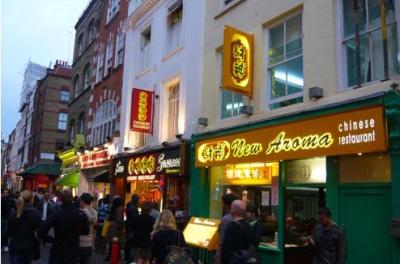
Chinatown just off Leicester Square for Chinese.
Edgware Road in Marylebone and Paddington is popular for Middle Eastern cuisine.
Drummond Street (just behind Euston railway station in the London/Camden
district) has lots of vegetarian restaurants - mostly Indian.
Golders Green for Jewish fare.
Kingsland Road for good cheap Vietnamese.
Finsbury Park and nearby areas for Greek and Turkish.
Other nationalities are equally represented and randomly dotted all over London.
It is usually wisest to eat in restaurants on main thoroughfares rather than on
quiet backstreets.
Restaurant Chains in London
Like other capitals in the world, London has the usual array of fast food outlets. Sandwich shops are the most popular places to buy lunch, and there are a lot of places to choose from including Eat and Pret a Manger. Some Italian-style sandwich shops have a very good reputation and you can identify them easily by looking at the long queues at lunchtime. If all else fails, Central London has lots of mini-supermarkets operated by the big British supermarket chains (e.g. , Sainsbury's, Tesco) where you can pick up a pre-packed sandwich.
Fast food with an Asian flare is easy to find throughout the city, with lots of Busaba Eathai, Wagamama, and Yo! Sushi locations throughout the city. Nando's has spicy peri peri style grilled chicken.
Vegetarian Restaurants in London
London has plenty of vegetarian-only restaurants many of them championing organic foodstuffs, and a quick search in Google will produce plenty of ideas, so you never have to see a piece of cooked meat all week.
If you are dining with carnivorous friends most restaurants will cater for vegetarians and will have at least a couple of dishes on the menu. Indian/Bangladeshi restaurants are generally fruitful, as they have plenty of traditional dishes. There are also many vegetarian Thai buffet places where you can eat somewhat unconvincing (but tasty) meat substitute grub for £5. These can be found on Greek and Old Compton Sts in Soho and Islington High Street.
Religious Restaurants in London
Due to the mix of cultures and religions, many London restaurants cater well for religious dietary requirements. The most common signs are for Halal and Kosher meat, from burger joints to nice restaurants. There are lots of Halal restaurants [92] and shops all over London including Whitechapel Rd and Brick Lane in the East End, Bayswater, Edgware Rd and Paddington and in many parts of north London. There are plenty of Kosher restaurants in Golders Green, Edgware and Stamford Hill.
Convenience stores and supermarkets
Convenience stores such as Tesco Metro, Sainsbury Central/Local, Budgens, Costcutter, SPAR, Somerfield as well as privately-run 'corner shops' sell pre-made sandwiches, snacks, alcohol, cigarettes, drinks etc. Most are open from 5AM-11PM although some such as Tesco Metro or convenience stores located at petrol stations may open 24 hours although they will stop selling alcohol after 11PM. Be aware that Whistlestop convenience stores (located in or around train stations) are notoriously overpriced and should be avoided. If using a petrol-station convenience store late at night (i.e. after 11PM) the store will be locked and you should order and pay through the external service window.
Full-size superstores such as Tesco, Asda and Morrisons are rare in the city centre and usually require a 15-20 min tube ride to reach them. One of the closest is the ASDA store close to South Quay DLR Station on the Lewisham line - about 15-min ride from Bank Station. There is also a Tesco in the Surrey Quays shopping mall which is next to Canada Water station on the Jubilee line - again about 10-15 minutes from the centre of town. If you plan on buying lots of groceries it's worth the trip as prices are much lower than in any downtown supermarkets.
Drink
Young and Beautiful
For more details on London's nightlife with attention on the alternative, try Indie London.
London is home to a great many pubs, bars and nightclubs. The online city guide View London [93] and the weekly magazine Time Out [94] can inform you of what's going in London's night life, as well as with cultural events in general.
Pubs & bars in London
London is an expensive place and your drink is likely to cost more than its equivalent elsewhere in the United Kingdom. Expect to pay around £3 for a pint of beer in an average pub, but be aware that as with restuarants, pubs close to major tourist attractions cash in on travellers' gullibility so be on your guard for the tourist traps where prices of £3.50-£4 are not unheard of. Despite this however it is still possible to find a sub-£3 pint in central London - it takes some determination - but many local pubs, especially those run by chains like Wetherspoons and Scream tend to be more reasonably priced with good drink promotions on weekday nights and during the day. As with the rest of the UK, chain pubs abound which Londoners tend to avoid like the plague.
In the Bloomsbury area, check out The Court (near the north end of Tottenham Court Road) and The Rocket (Euston Road). Both are fairly cheap to drink at, given that they cater for students of the adjacent University College London. Directly opposite the British Library is The Euston Flyer, popular with locals and commuters alike given its close proximity to St Pancras International railway station.
Classier bars and pubs can be much more expensive. However, the cost of alcohol drops significantly the further away you go from the centre (though be aware that West London tends to be an exception, with prices pretty much the same as the centre).
Two important London breweries are Young's and and Fullers. Young's was founded in Wandsworth in 1831 and nowadays it boasts 123 pubs in central London alone. The Founder's Arms on the South Bank is one of the brewery's most well known establishments. Fullers was founded a bit later in 1845 and the jewel in its crown is probably the Grade I listed Old Bank Of England on Fleet Street, thanks to its breath-taking interiors.
It's hard to say which pub in London is truly the oldest but it's easy to find contenders for the title. Many pubs were destroyed in the Great Fire of London – indeed, Samuel Pepys supposedly watched the disaster from the comfort of the Anchor in Borough. Pubs were rebuilt on sites that claimed to have been working pubs since the 13th century. Ye Olde Cheshire Cheese in Fleet Street is on the site of an old monastery and its cellar dates back to the 13th century. Those interested in London's historic and literary connections can't miss The Spaniard's Inn in Hampstead. Dick Turpin is said to have been born here; John Keats and Charles Dickens both drank here; it's mentioned in Dickens' The Pickwick Papers and Bram Stoker's Dracula.
For the best view in the city, try pubs on the banks of the Thames. The South Bank has lots of good bars with plenty of iconic bridges and buildings in sight the cocktail bar in the OXO tower is a secret that most tourists walk by everyday. Heading towards Bermondsey, pub crowds become a little less touristy.
If you're after gastropubs, you may like to visit London's first, The Eagle, in Clerkenwell, established in 1991. You can also try Time Out's favourite newcomer, The Princess Victoria on Uxbridge Road, Shepherd's Bush.
Wine buffs can enjoy the famous Davys wine bars that dot the city. The company, established in 1870, import wines and own over thirty bars in the centre. Other big names in wine include the Michelin-starred Cellar Gascon and Vinoteca, both in Smithfield.
Big hotels, such as The Dorchester and The Ritz, and upmarket clubs around Leicester Square and Soho are reliable bets for a date at the bar. The Connaught Hotel in Mayfair-Marylebone boasts its house bar, plus the Time Out favourite, The Coburg. Still in Mayfair, The Polo Bar at The Westbury is very intimate.
You can rely on most up-and-running bars to offer a short cocktail menu and there are also bars that position themselves as cocktail specialists.
Nightclubs in London
Nightlife is an integral part of London life and there are countless nightclubs in and around Central London with music to suit even the most eclectic of tastes. Districts in London tend to specialize to different types of music.
The Farringdon/Hoxton/Shoreditch area has many clubs playing drum and bass, house and trance music and is home to the superclub Fabric (arguably the best nightclub in London). The clubs in this area are often home to the world's top DJ's and attracts a lively, hip and friendly crowd.
The area around Mayfair is home to the more up-market clubs in London. This area attracts a rather more showy crowd who love to flaunt what they have and is a must go to celebrity spot. Beware that drinks are ridiculously expensive and many clubs operate a guestlist-only policy. Music played here is often of the commercial chart, funky house, hip hop and R&B genre. Notable clubs include China White, Funky Buddha, Mahiki, No 5 Cavendish Square, Embassy, Vendome and Maya.
Nightclubs around the Leicester Square area hold the same music policy, but are rather more accessible, with numerous club promoters scattered around the area on a Friday or Saturday night offering deals on entry. Notable clubs are Cafe De Paris, Number One Leicester Square, Sound, Tiger Tiger, Zoo, Ruby Blue.
The Camden area is home to lots of clubs which play Indie, metal and rock music and notably the Electric Ballroom, the world famous Koko and Underworld.